
Key Takeaways
- 3D rendering outsourcing means hiring an external studio to turn your files into renders, animations, and 3D models.
- Main benefits are lower overhead, specialized expertise, flexible capacity, and faster launches.
- Success depends on a complete brief, clear approvals, and a defined scope.
- Choose a partner by portfolio, case results, capacity, communication, and transparent pricing.
- PIXREADY provides scalable, photorealistic CGI with a dedicated project manager and hybrid 3D + AI workflows.
Architects, developers, and product brands increasingly turn to 3D rendering outsourcing when visual demand grows faster than an in-house team can handle. Whether the need is product renders, architectural visuals, or animation, the question is the same. How to get reliable results without overstretching the budget? Yet the market is crowded, prices vary widely, and a wrong choice costs time and money. This guide explains how outsourcing works, what it costs, which projects suit it, and how to evaluate a CGI partner.
What is 3D Rendering Outsourcing?
Outsourcing 3D rendering means commissioning an external provider to turn CAD files, drawings, sketches, or reference photos into 3D models, photorealistic images, animations, or interactive assets. Businesses can outsource product renders, architectural and interior visualization, 3D modeling, animation, 360 views, and configurators, while their own teams keep control of design and marketing.
The main choice is between a freelancer and a studio. A freelancer is one person, which suits small, one-off tasks with a narrow scope. A 3D rendering provider, such as a professional 3D visualization studio, offers a team of modelers, artists, and a project manager. So capacity, quality control, and deadlines don't depend on a single individual.

In-House 3D Rendering vs. Outsourcing: Which is Better for Your Business?
Neither option is universally better. The right choice depends on production volume, expertise, budget, project frequency, and the level of creative control you need. When choosing between an internal team and a 3D rendering outsource partner, compare them on the criteria below.
When Should a Business Build an In-House 3D Team?
An in-house team makes sense when CGI demand is continuous and predictable, and the business needs daily creative control. It works best when experienced artists and production infrastructure already exist, and when designs go through frequent iterations.
When Is Outsourcing 3D Rendering the Better Option?
Outsourcing suits occasional or project-based work, large projects that exceed internal capacity, and tight deadlines. It also fits businesses that need specialized expertise, want to avoid production overhead, or want to outsource 3D visualization services such as rendering, animation, and modeling to one studio. According to The CMO Survey, US companies outsource on average a third of their digital marketing activities, and the most-cited capability gap is a lack of people, time, and budget (22.3%).
How Much Does 3D Rendering Outsourcing Cost?
The cost of outsourcing 3D rendering depends on project type, modeling complexity, number of visuals, realism requirements, available assets, and delivery schedule.
Main cost factors:
- Project type: product, interior, exterior, animation, or tour.
- Modeling complexity: simple shapes versus detailed facades, furniture, or custom products.
- Number of visuals: single views versus packages and catalogs.
- Realism requirements: level of material, lighting, and scene detail.
- Available assets: ready CAD or BIM files reduce modeling time.
- Delivery schedule: rush deadlines raise the estimate.
PIXREADY’s average rates for typical 3D rendering outsourcing services are:
Project materials usually form the basis for budget and scope estimates, so complete briefs and files keep quotes accurate. Modeling is calculated separately for interior and exterior projects, and large-scope projects may receive a 10-15% discount. Because outsourcing 3D renders is priced by scope, the most reliable way to budget is to share drawings, references, and deadlines and request a project-specific estimate.
How Can Businesses Reduce Outsourcing Costs?
Costs in 3D rendering fall when the brief is complete and the process is organized. These practices help:
- Prepare complete technical documentation, including CAD files, drawings, and references.
- Consolidate feedback into one review instead of several small rounds.
- Reuse existing 3D models and approved materials.
- Plan recurring production so assets and styles carry over.
- Group similar products and scenes into batches.
- Define deliverables and revisions before production starts.
Project materials are the basis for budget and scope estimates.
How Long Does Outsourced 3D Rendering Take?
Timelines vary with complexity, scope, and how quickly feedback and approvals arrive. To outsource rendering with predictable deadlines, confirm the schedule before production starts. Approval speed matters too: quick, consolidated feedback keeps schedules short. PIXREADY’s typical timelines are shown below; catalog and configurator timelines are set after scope review. Current rates are on the PIXREADY pricing page.
What Are the Benefits of Outsourcing 3D Rendering?
Outsourcing gives businesses access to specialized expertise and flexible production resources without requiring them to build and maintain a complete internal visualization department. For companies considering 3D rendering outsourcing, the main advantages fall into five areas.
Reduced Overhead and More Predictable Project Budgets
Outsourcing removes the need to buy software and hardware or to hire, train, and retain artists. Businesses pay for the visuals they need, and a defined scope with a clear estimate makes project budgets easier to plan.
Access to Specialized 3D Visualization Expertise
A studio brings modelers, lighting and material artists, and animators who work with current software and techniques. This helps when a project needs product, architectural, interior, or animation expertise that a small internal team may not cover.
Faster Project Execution and Flexible Workload Management
Companies that outsource 3D rendering services can add production capacity for launches, presales, and campaigns, then scale back when demand drops. External teams work to agreed deadlines, so internal staff are not stretched by peaks.
Focus on Core Business Activities
With rendering handled externally, designers, architects, and marketers can concentrate on strategy, client meetings, and product development instead of production tasks. A dedicated project manager coordinates timelines and feedback.
Consistent Visual Quality Across Projects
Studios work from standardized models and defined review steps, so product ranges and property portfolios maintain a consistent visual style. Businesses that outsource CGI visualization also reuse approved assets across catalogs, listings, and campaigns. Accuracy matters beyond style: 45% of shoppers surveyed by Salsify had returned an online purchase in the past year because of incorrect product content.

What Are the Disadvantages of Outsourcing 3D Rendering?
Outsourcing works best when expectations, communication, and quality control are clear from the start. Any 3D rendering outsource partnership has trade-offs, and most can be managed with the right preparation.
Less Direct Control Over Production
Clients do not supervise every production step, so approvals depend on structured checkpoints. Agreeing on review stages, such as model, materials, and final render, keeps direction in the client’s hands.
Communication Barriers and Time Zone Differences
A distant team can slow feedback if channels are unclear. PIXREADY works with clients across time zones through video calls, email, and shared review tools, with a dedicated project manager coordinating communication.
Inconsistent Quality and Unrealistic Expectations
Quality varies between providers, and vague briefs lead to results that miss expectations. Reviewing a portfolio, sharing references and style guidelines, and agreeing on revisions upfront reduce that risk, and a 3D visualization outsourcing studio with a defined process keeps results consistent.
Additional Costs and Scope Changes
Costs can grow when scope changes after production starts. Defining deliverables, number of views, and revision rounds before work begins, and requesting a clear estimate, keeps the budget stable. Sharing complete files early also helps.
Which Industries Benefit Most from Outsourcing 3D Rendering?
Industries with recurring visual demand, tight launch schedules, or products and projects that do not exist yet benefit most, because outsourcing supplies CGI capacity without a permanent team. Businesses in these sectors typically choose a 3D visualization outsource partner for the needs below.
For product-led businesses, the main advantage is volume: one set of 3D models supports catalogs, ads, and configurators. For real estate and architecture, it is speed to market. In NAR’s 2025 Profile of Home Buyers and Sellers, 81% of buyers who searched online rated photos as very useful, ahead of detailed property information (77%).
Marketing agencies value flexible capacity, since campaigns arrive in peaks. Businesses that outsource rendering services benefit most when demand is variable, and visuals must stay consistent.
Why Choose PIXREADY for 3D Rendering Outsourcing Services?
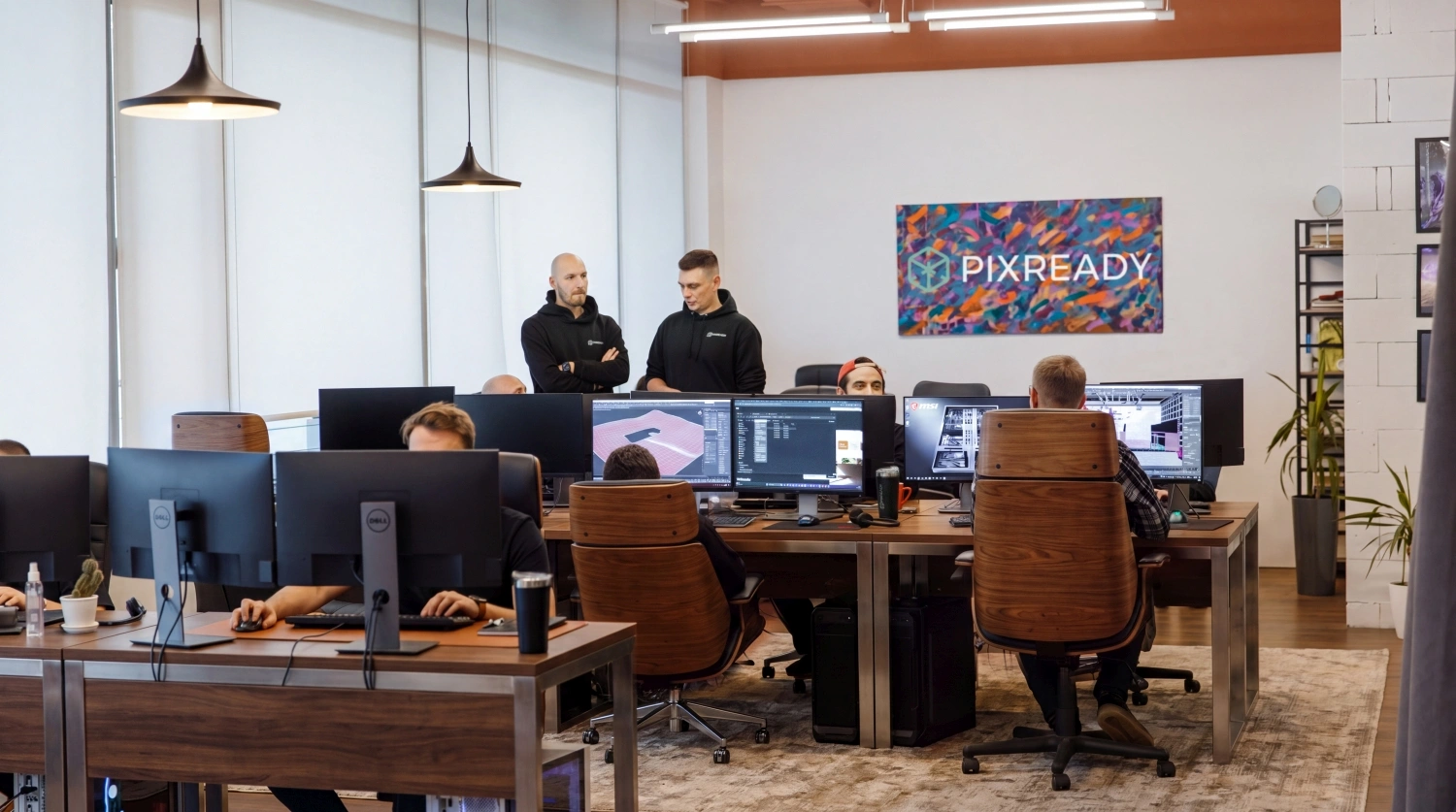
PIXREADY is a 3D visualization company that works as an external CGI production partner, and its workflow addresses the main risks of any 3D rendering outsource engagement, like control, communication, quality, and cost.
- Scalable 3D visualization services across industries: PIXREADY covers product and eCommerce visualization, furniture rendering and manufacturing CGI, architectural, interior, and real estate rendering, and animation, so one partner can serve several departments and projects. Industries served include eCommerce, manufacturing, real estate, architecture, and marketing.
- Dedicated project management and structured production: A dedicated project manager coordinates timelines and feedback, and production follows defined stages from brief and modeling to review and delivery. This gives clients clear checkpoints.
- Production capacity for individual projects and large-scale requirements: With 50+ 3D professionals, PIXREADY handles single visuals and large catalogs. For Hoodsly, a US custom range-hood manufacturer, the team built a 3D configurator that expanded customization from 13 colors to 101,088 options, as reported on the project page.
- Photorealistic CGI and hybrid 3D + AI workflows: Photorealistic renders are built from accurate 3D models, materials, and lighting. AI-enhanced tools speed up ideation and variations, while artists keep control of geometry and final quality.
- Transparent pricing and project terms: PIXREADY provides clear estimates with no hidden fees, based on project materials, and rights to the final visuals transfer after full payment. See the pricing page for current rates, so buyers of 3D rendering outsourcing services can budget before they commit.
Case in Practice: Lifestyle Renders for Storage Solutions
A Dutch company specializing in innovative storage solutions needed to show the functionality and design of its products in various home settings. A dedicated project manager handled communication, while PIXREADY’s rendering artists modeled the products, placed them in different room settings, and added realistic lighting and textures. The deliverables were a series of room-setting renders in the file formats suited to the client’s marketing needs. Timelines were consistently met, usually within a week, and the client reported faster, better theme and ambient renders than expensive photo shoots.
In the client’s words:
“PIXREADY delivered exceptional value for money, providing us with fast, high-quality output. The project timelines were consistently met, usually within a week.”
Case in Practice: Exterior Renderings for Off-Plan Townhouses
A US real estate development company had a townhouse project still under construction and needed to present the design to potential buyers and investors before completion. PIXREADY created photorealistic architectural renderings that emphasized the sleek lines, natural lighting, landscaping, and surroundings, delivering a set of exterior renderings of the townhouse buildings. The visuals replaced physical mock-ups, helped secure faster project approvals, attracted early interest from buyers and investors, and supported pre-sales, which reduced financial risk and accelerated the project’s timeline.
The project coordinator said:
“PIXREADY delivered outstanding 3D renderings with excellent service and communication throughout the project. The team was responsive, making revisions quickly and accurately.”

How Does the 3D Rendering Outsourcing Process Work?
A typical outsourcing project moves through five steps, from the first brief to final handover, with a clear approval point at each stage.
- Step 1. Project Brief and Requirements: The client shares the project type, goals, CAD files, drawings, sketches, or references, along with style, file formats, and deadlines. The more complete the brief, the closer the first drafts are to the intended result.
- Step 2. Project Evaluation and Cost Estimation: A 3D rendering outsourcing service provider reviews the materials and returns a clear estimate and timeline before production starts, since the project materials form the basis for budget and scope. Deliverables, views, and revision rounds are agreed at this stage.
- Step 3. 3D Modeling and Visualization Production: artists build accurate 3D models, apply materials, lighting, and textures, and set up scenes or animations, while a dedicated project manager coordinates communication and timing.
- Step 4. Previews, Feedback, and Revisions: The client reviews previews and sends consolidated, specific feedback. The team revises until the visuals match the brief, within the agreed number of revision rounds.
- Step 5. Final Delivery and Asset Handover: After final approval, the studio delivers renders, animations, or models in the formats needed for marketing, and reusable 3D assets can support future projects.
Well-run 3D rendering depends on a complete brief, clear approvals, and one point of contact. PIXREADY’s workflow follows these stages, so clients know what to provide and what to approve at each step.
Conclusion
3D rendering outsourcing works best when visual demand is variable, deadlines are tight, or a project needs specialists that an in-house team does not cover. The result depends not only on the studio but also on preparation. A complete brief, a defined scope, consolidated feedback, and clear approval stages keep both budget and timeline predictable. When comparing partners, look at portfolio and case results, production capacity, the communication process, and pricing transparency.
PIXREADY works as an external CGI production partner for product brands, real estate developers, architects, and marketing agencies, with a dedicated project manager and hybrid 3D + AI workflows. To get a project-specific estimate, share drawings, references, and deadlines with the PIXREADY team.
Get 3d expert on your side
More than a 3D rendering vendor, PIXREADY acts as a strategic CGI partner helping brands
сreate scalable visual content for marketing, sales, and product launches. Let's explore your
project and discuss how CGI can support your business goals!

Stas Dunaevskiy is an Account Manager and Business Development Specialist at PIXREADY, a company focused on scalable CGI production and architectural visualization. He helps clients explore the possibilities of cutting-edge CGI technologies, with a special focus on immersive 3D walkthroughs, virtual tours, and architectural visualization. He has worked with real estate developers, construction companies, and product manufacturers, guiding them toward solutions that bring their projects to life and support business goals. With his consultative approach, Stas ensures that each PIXREADY project combines creative vision with the latest advancements in 3D visualization.